

Five things in the Issue #1. Three of them are about where value is concentrating in the AI cycle and who is capturing it, from the application layer all the way up to the hyperscalers collecting the infrastructure bill. The other two are about something less discussed: the cost of patience and conviction, and what happens when ownership structures no longer permit either. One of those is about venture capital. The other is about football. The underlying question is the same.
1. The Gen AI Value Chain: Still Inverted,
The Economics of Generative AI: Two Years Later, Apoorv Agrawal (Altimeter)
Two years ago I shared my thoughts on the Altimeter piece about the Gen AI value pyramid being inverted, with semis and infra capturing the overwhelming share of revenue and gross profit while the app layer earned almost nothing. The latest update from Altimeter shows that although ecosystem has grown 5x to ~$435B in annualised revenue, the distribution has barely shifted. Semis still command ~70% of revenues and ~79% of gross profits. At the current pace of change, we are well over a decade away from anything resembling the cloud stack, where apps capture 70% of gross profits and semis just 6%.
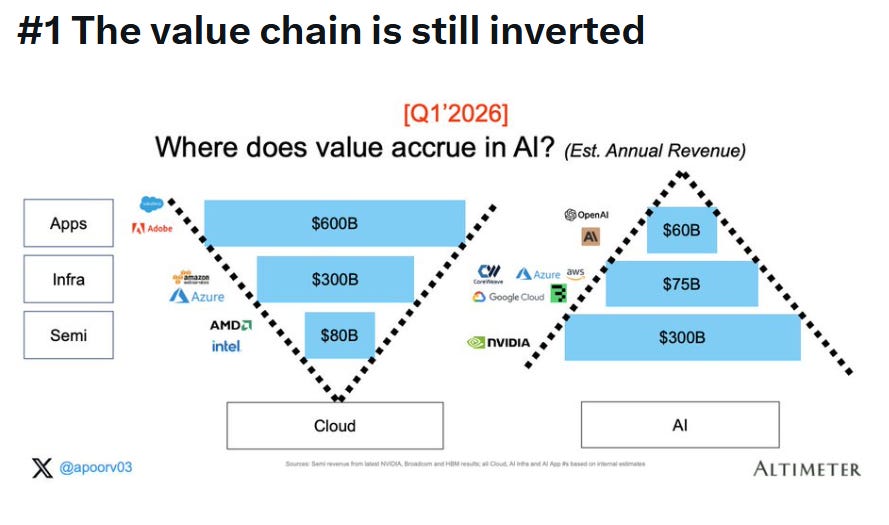
NVIDIA still holds ~80% of the semi layer, though custom silicon is becoming a credible hedge. Google’s TPU has reportedly forced meaningful pricing concessions from NVIDIA and is increasingly gaining share for inference workloads, and Amazon’s Trainium has crossed $10B in run rate. But margins at the top have not yet cracked.
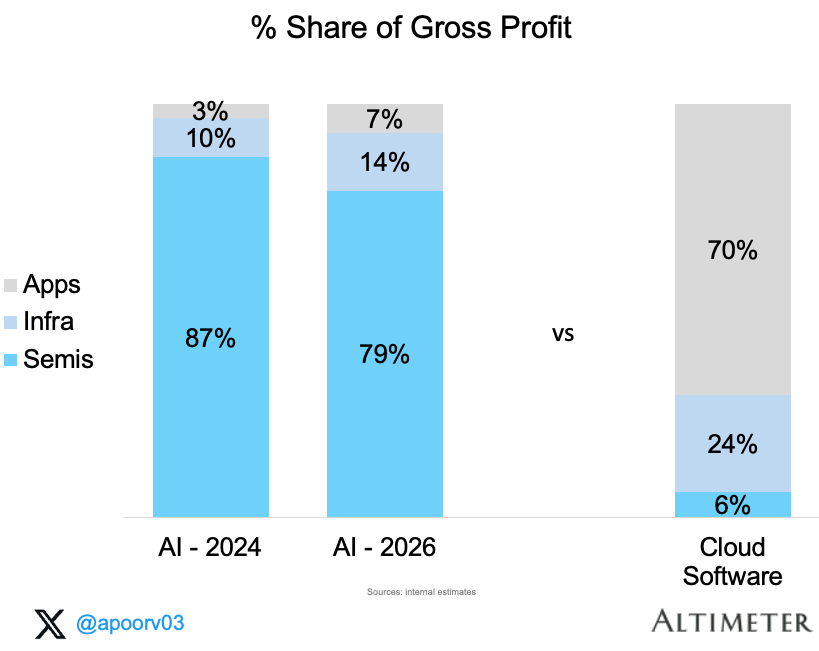
The more interesting development is in apps. The Cambrian explosion in the AI app sphere we saw is giving way to increasing concentration. OpenAI and Anthropic together account for ~75% of the layer at $40-50B in annualised revenue, absorbing workflows many assumed would be open territory, whilst also eating the traditional SaaS business’ lunch. Vertical specialists like Harvey, Cursor and Lovable are building real businesses but sit in somewhat distant (but adjacent) tiers. The line between a defensible AI product and an expensive wrapper is now the central question at the application layer.
There might be a credible path to better app layer economics however. Inference costs have fallen roughly 1,000x since 2022, with the pace of decline accelerating sharply after May 2024. If pricing holds while costs continue falling, app layer gross margins of ~33% today have real room to expand.
The deeper question is whether app companies can build structural advantages fast enough, through switching costs, proprietary data, and genuine workflow lock-in, before model providers absorb their categories from below. The moat question has not been clearly answered yet I think.
2. Big Tech Earnings: Do you see the ROI now?
Q1 2026 Earnings — Alphabet, Microsoft, Amazon, Meta
The market spent most of 2024 asking when the AI capex would start paying off. Q1 2026 might be the clearest answer yet.
Some numbers from this Q first. Google Cloud grew 63% YoY, crossing $20B in quarterly revenue for the first time, with Cloud operating margins nearly doubling from 17.8% to 32.9%. AWS grew 28%, its fastest rate in 15 quarters, with Amazon’s overall operating margin hitting a record 13.1%. Microsoft’s AI business crossed a $37B annualised run rate, up 123% YoY. Meta reported 33% revenue growth and a 41% operating margin, its strongest in four years, with AI-powered ad ranking driving a 12% YoY increase in average ad prices.
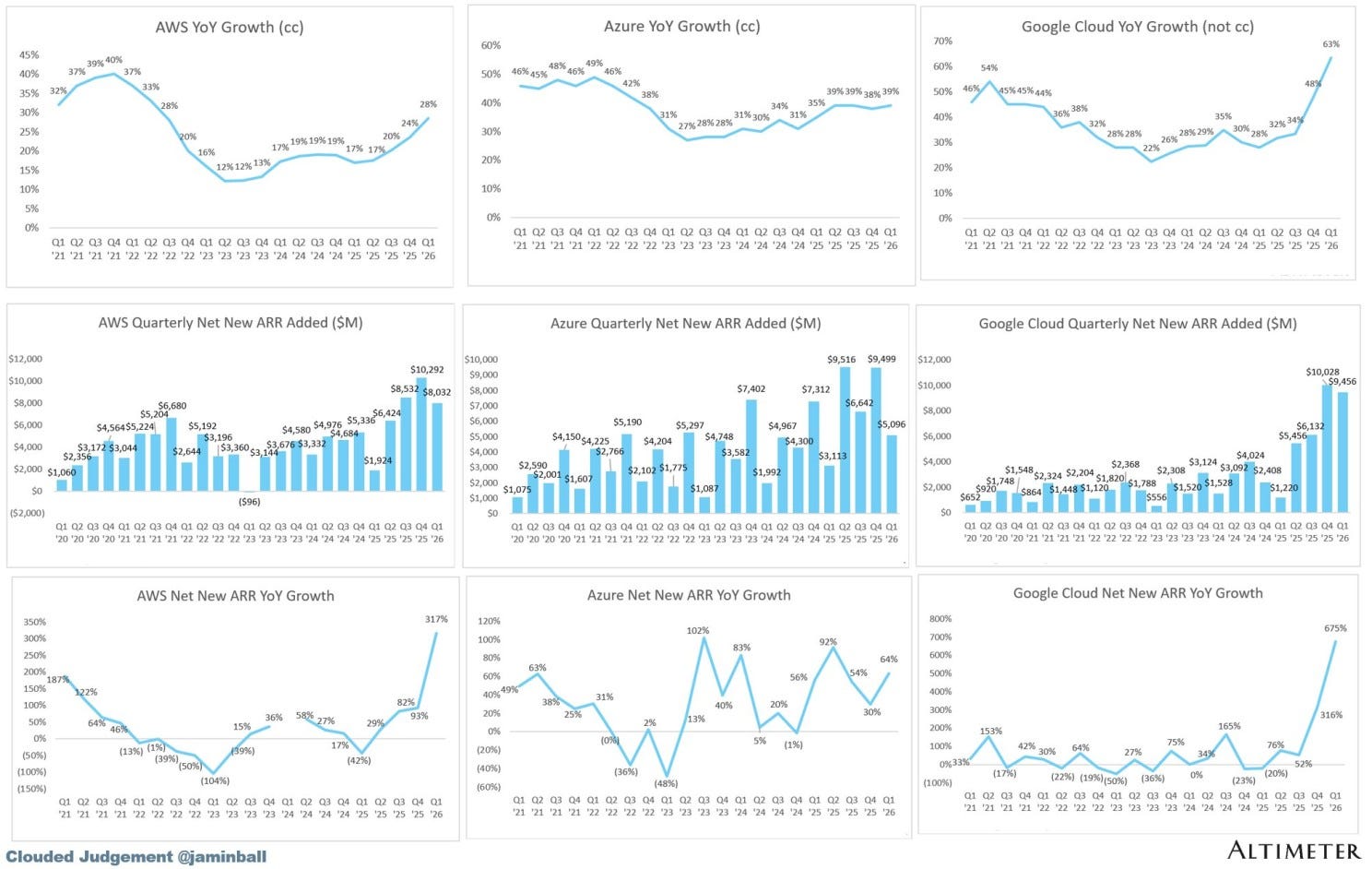
I feel like I have been saying this every quarter, but the AI capex and the investments are making their existing businesses structurally more profitable. Incremental margins for Big Tech, especially the hyperscalers are trending up. AI linked Cloud products are absorbing the VC dollars raised by the largest AI companies. Their investments in custom ASICs and semis are driving margins higher with these semis being cheaper and more efficient. And the equity linked deals they have signed with the frontier model labs are now worth many times over.
The SaaS cycle taught us that VC dollars raised by startups get recycled into cloud spend. The AI cycle seems like it has the same dynamic, but at almost ten times the scale.
3. The Q1 2026 Venture Monitor: Concentration is the word
PitchBook-NVCA Venture Monitor, Q1 2026
Venture capital continues to become a game of consensus and a concentrated bet. A record $267.2B deployed in a single quarter. The top five deals (OpenAI, Anthropic, xAI, Waymo, Databricks) absorbed $195.6B, or 73.2% of all venture capital deployed. AI companies captured 88.8% of total deal value. Valuation premiums widen dramatically at late stage: median Series D+ AI companies are valued at $4.7B versus $1.28B for non-AI peers. On the fundraising side, six managers captured 76.2% of all capital raised, while median fund size fell to $15.3M from $25M in 2025. The market is concentrating at both ends simultaneously.
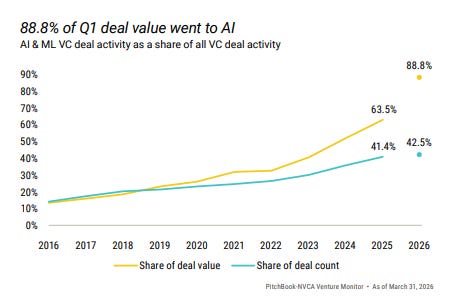
Something interesting is to observe where that capital actually flows. In the SaaS decade, VC dollars raised by software startups were recycled into AWS and Azure spend diffusely, thousands of companies each allocating a share of their runway to cloud hosting, collectively driving AWS from ~$5B in annual revenue in 2015 to ~$46B by 2020.
The mechanism in AI is identical but the leverage is an order of magnitude higher and far more direct. Frontier model labs spend the majority of their capital on compute. Anthropic alone has committed over $100B to AWS and tens of billions more to Google. Combined cloud revenues across AWS, Azure and GCP have grown from ~$200B in 2023 to a ~$370B annualised run rate entering 2026.
The VC mega-round is almost becoming the forward purchase order for compute infrastructure, which is further flowing into semis, memory providers and other players in the ecosystem (and we can see where the value is accruing from above)
4. The High Cost of True Conviction: Finding the arbitrage
The High Cost of True Venture Conviction
Most venture firms describe themselves as conviction investors. Very few actually are. The piece makes the case that truly differentiated conviction has become almost extinct in institutional venture, because the incentive structures systematically punish it. At every layer of a partnership, from the associate memo to the LP update, original conviction leaks out. Founders who pattern-match survive the translation. Those who do not die in it.
The investment that actually returns the fund is one where the founder is highly unusual, the market is unproven, the comparable does not exist, and at least two of your partners think it is a mistake. Airbnb was passed on because renting your bedroom to strangers sounded insane. Shopify was a German snowboard shop owner in Ottawa building software nobody asked for.
The framework I would add is the conviction-consensus arbitrage. Conviction only generates outsized returns when it is built before something becomes consensus. By the time a thesis is widely accepted, the upside is already compressed into the entry price. The real work is knowing precisely what is driving your conviction: is it the founder, a variant view on the market, something structural you believe that others do not?
And equally important: what specifically needs to happen for it to become consensus? That question is what separates a thesis from a hunch. As the piece puts it, if the process produces consensus, the portfolio will produce average returns, no matter what the fund deck says.
5. The Premier League’s Era of Disposable Managers
The Premier League’s Era of Disposable Managers, Financial Times
Here is what went on this season: nine full-time managers were sacked during the 2025-26 Premier League season. Departing managers lasted an average of 295 days in charge, the lowest since the league was founded 34 years ago and well below the previous record low of 415 days set in 2008-09. Nottingham Forest cycled through four managers in a single campaign. Ange lasted 39 days, Tudor 44 days at Spurs, Amorim 14 months at United, Maresca 18 months at Chelsea.
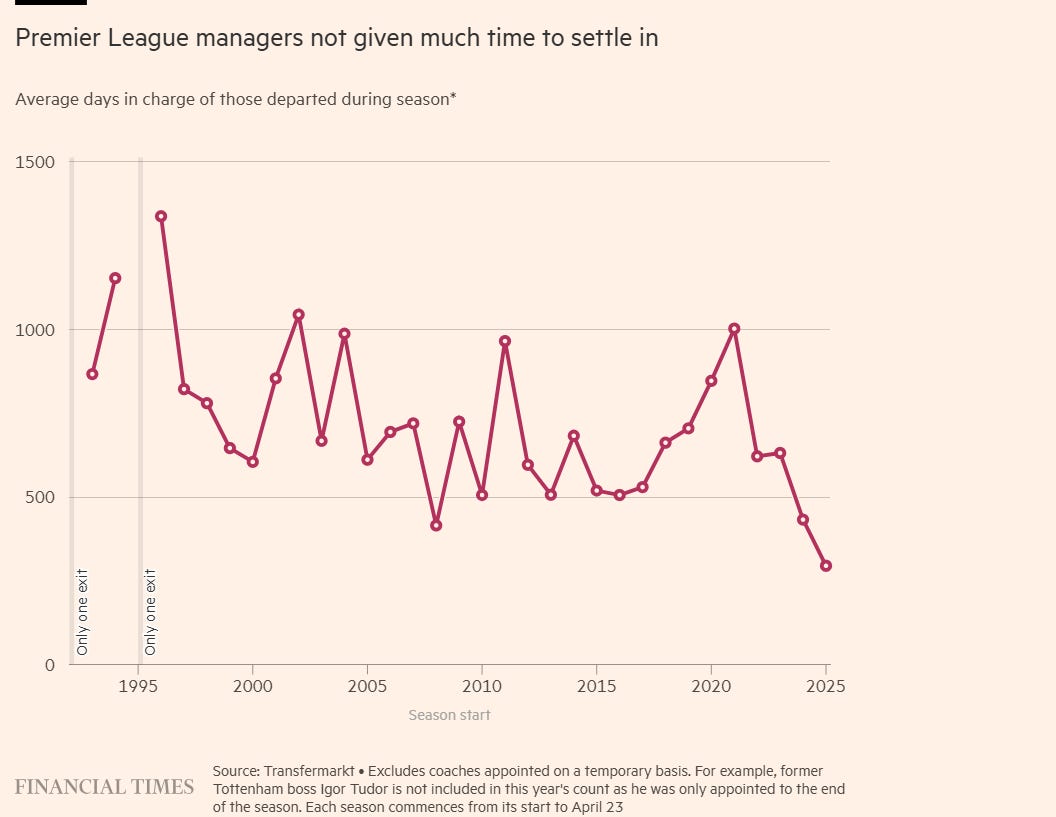
The financial logic is easy to understand. Relegation and European qualification money have made patience too expensive for most owners. But the structural shift underneath is less discussed. Private equity and financial investors now own significant stakes across the league, and they have brought a different operating model with them.
Managers are increasingly called head coaches, a linguistic shift that tells you exactly where the decision-making power now sits. Sporting directors, data teams and ownership groups set the strategy and the head coach executes it. When execution falls short, the replacement cost is lower than the opportunity cost of staying the course.
People usually forget about the time Mikel Arteta had to get where he has got to. He was given three full years despite lacklustre results, and was consistently backed in the transfer market, and allowed to build a squad and an identity before the results came. That kind of patience produced one of the most consistent sides in Europe. It is also, increasingly, a relic. Football clubs no longer want to play the long game, even when the long game is the only one that consistently wins.
Hope you enjoyed Issue #1 of The Atomic Radar!
Until next time,
The Atomic Investor