

Concentration is the word that kept surfacing this week, in public markets, in venture funds, even inside single AI labs eating up whole categories of deal flow. Some of it holds up when you actually look at the fundamentals. Some of it is just a herd finding warmth.
This issue pokes at both kinds, plus why hardware is suddenly interesting again and why your air conditioner turned into an investment thesis.
1. Busting the market concetration myths
J.P Morgan Eye on the market (July 26 report)
Many investors make the case against investing in the U.S stock markets, arguing that it is “expensive”, in a “bubble” or too concentrated.
There is no question about the U.S taking over a majority share of the global equity market cap since the early 2000s and reaching the levels where it used to be around the 1970s.
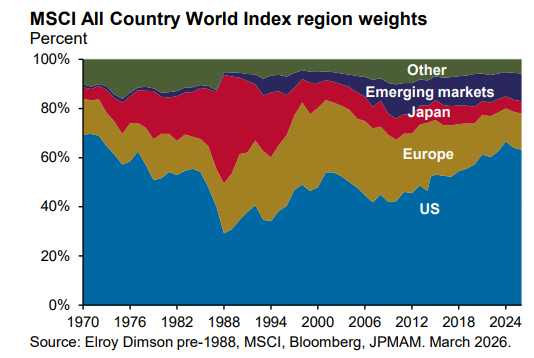
Some might say it was the ZIRP (zero interest rate policy) era, others might call it over-exhuberance, or attribute it to the dollar being the reserve currency that continues to drive demand for U.S assets.
But few give credit to the actual business fundamentals of U.S stocks. Almost every major sector has higher return on equity (ROE) and return on assets (ROA) in the U.S, meaning higher returns per dollar of equity and per dollar of assets on their balance sheet.
And no its not just due to “Tech” (trying to pre-empt your next argument there).

On the index concetration argument, there is a reason why tech makes up almost 40% of it. Technology stocks have much higher free cash flow margins and continue to compound their earnings at much higher rates.
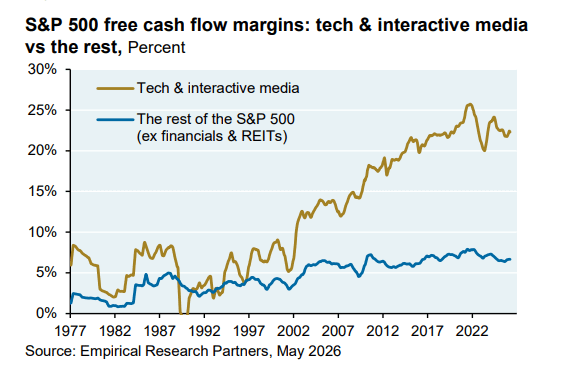
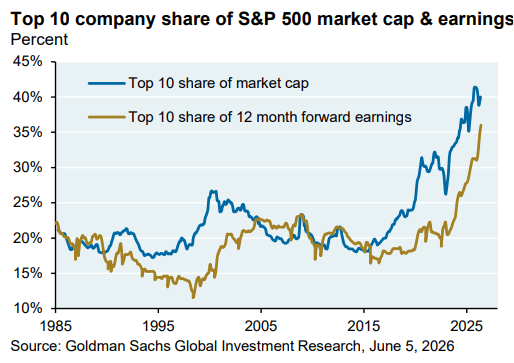
Finally, equity market concentration at the index level (measured by market cap share of top 10 stocks) is actually one of the lowest as compared to the rest of the world.
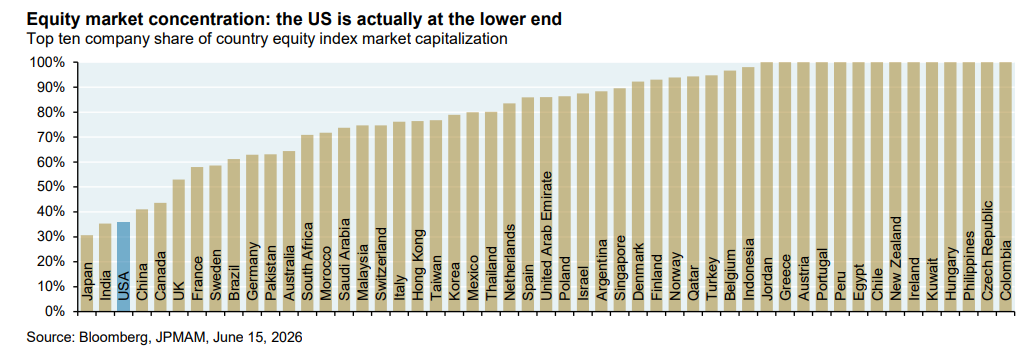
All this does not mean there cannot be over exhuberant periods or areas within the market where prices or valuations get detached from fundamentals and the realities of the world.
But at the overall market level, the U.S domination seems fairly justified.
2. “Bits to Atoms” is starting to play out
We have heard investors talking about the “Bits to Atoms” thesis a lot lately, which basically translates to the focus shifting from software-first capital light models to the hardware or hardware-like asset heavy ones.
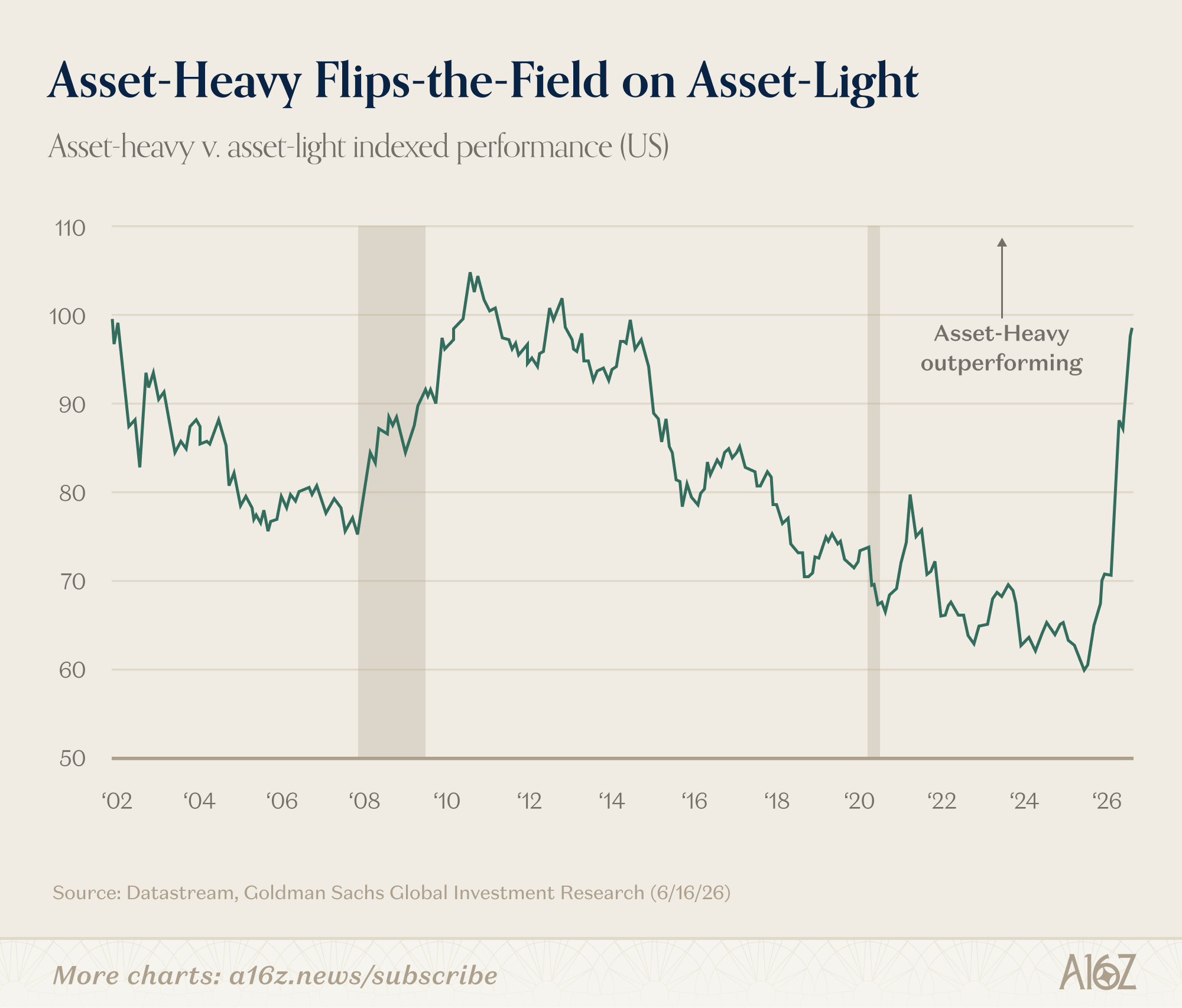
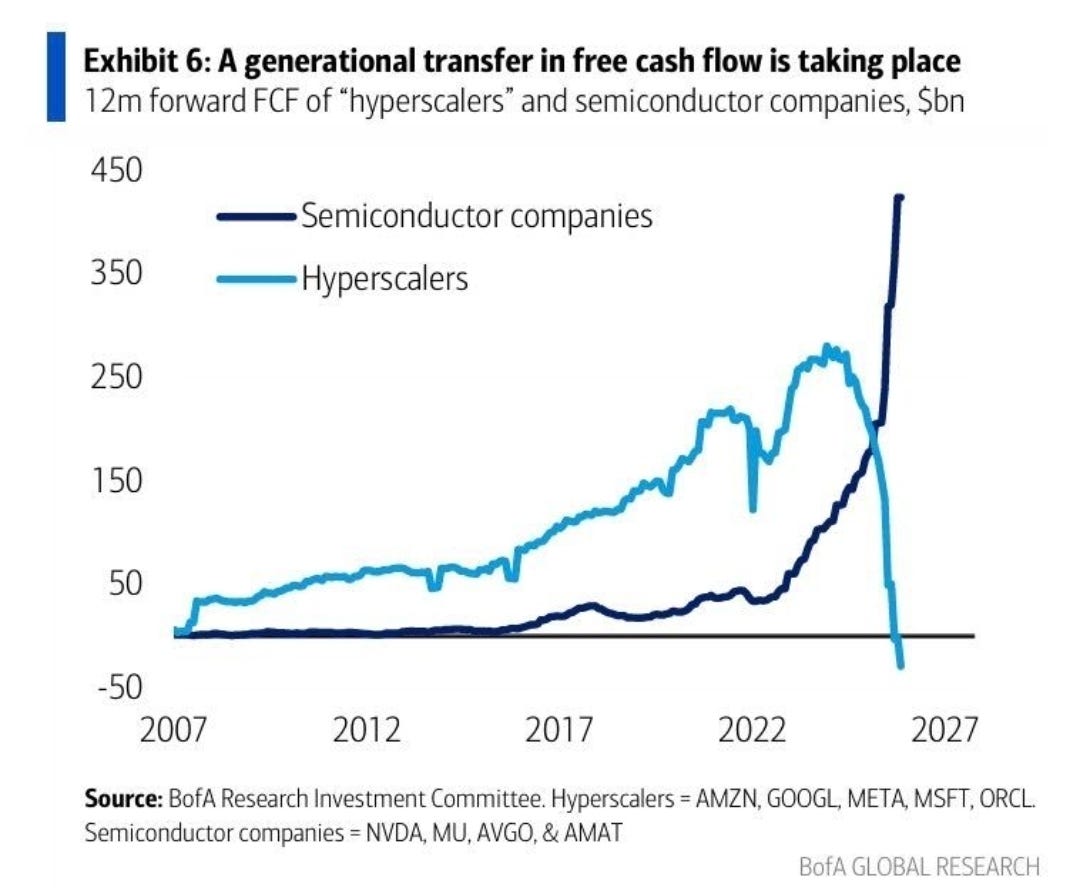
This seems to be driven by the part of the AI cycle we are in - one of the largest capex deployment periods we have seen in history where the Mag 7 / Big Tech stocks, along with large private institutional investors are expected to deploy almost a trillion dollars this year building out compute capacity and related infrastructure.
This is translating into billions spent on memory, chips, servers, networking equipment, energy and other data centre infrastructure. Here is a fascinating chart showing the fastest free cash flow transfers from buyers of hard tech. to the suppliers of it.
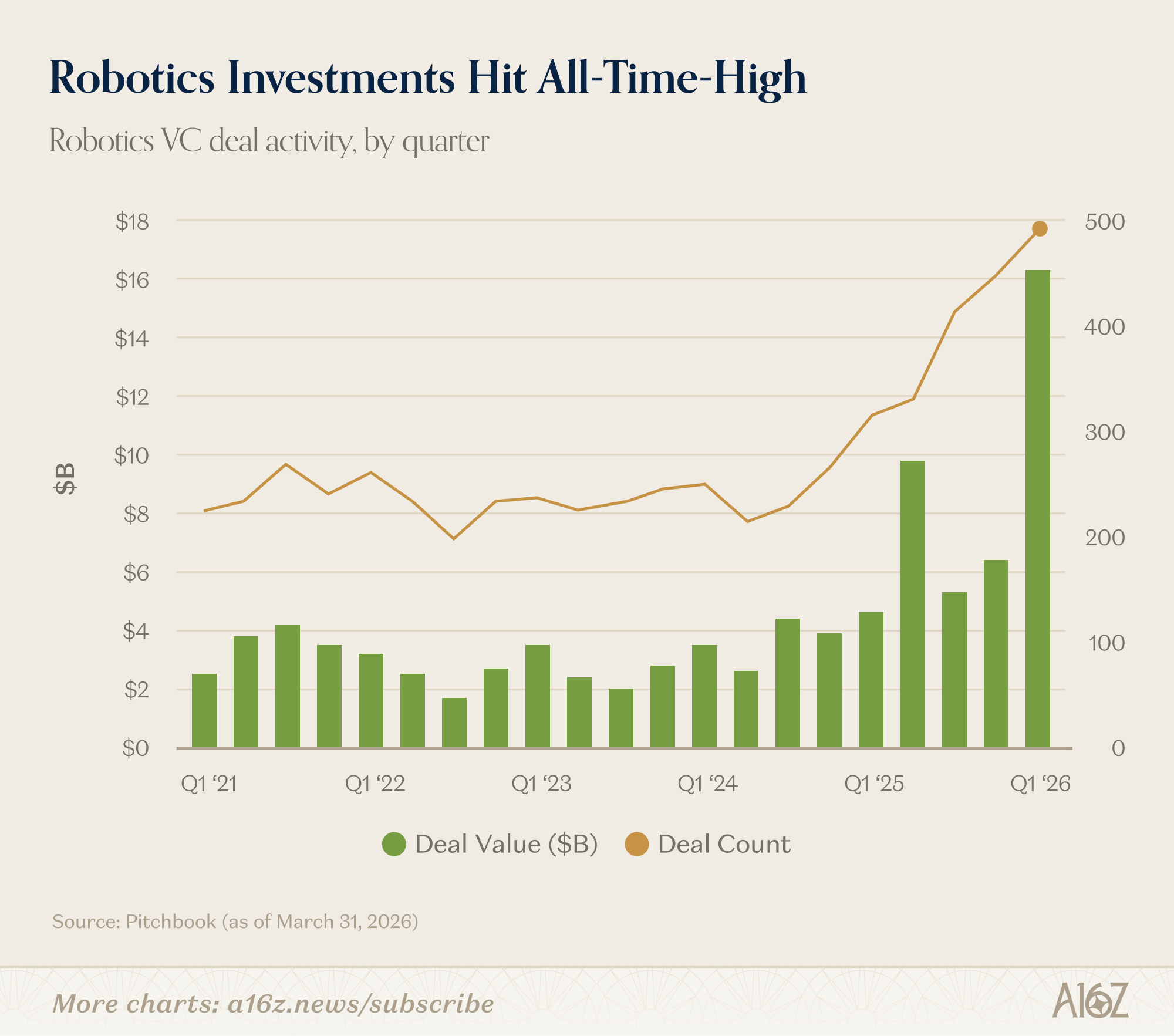
But this is not just about rotation to AI linked hardware. Hardware or hard assets are attracting increasing amounts of capital. Robotics and Physical AI had its biggest Q ever in terms of deal count and value this year.
Hardware was long considered unattractive due to long lead times to market and large amounts of capital required. But AI itself is compressing development times across hardware and deep tech categories as software that powers the design, simulation, materials science and manufacturing iteration ships in days instead of months and runs experiments at a much shorter timeframe than before.
3. Sweltering summer beneficiaries
Aircon stocks become next hot bet as Europe wilts - Financial Times
The European summer continues to break temperature records. Heat waves have become increasingly common, and red alerts due to record temperatures are being issued across the region’s major capitals again this year.
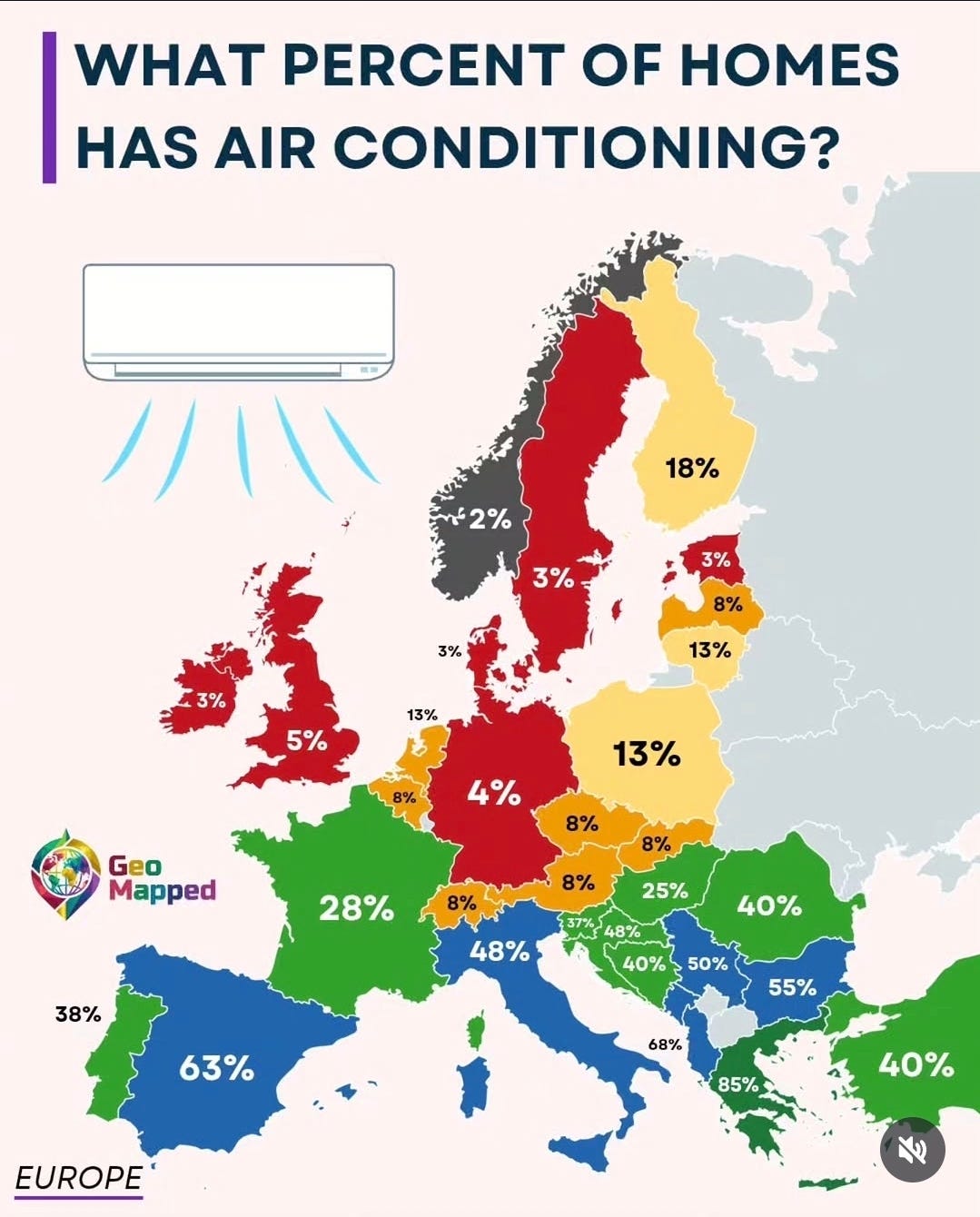
One of the clearest beneficiaries of this trend are air conditioning or HVAC companies. AC penetration in Europe hovers around 20% as compared to 90% in U.S and Japan. IEA forecasts household penetration to reach 50% by 2035 in the EU, doubling the installed base to around 275mn units.
There is a huge disparity between EU countries, which highlights where the opportunity lies directionally.
As a result, the largest aircon stocks have started showing some signs.
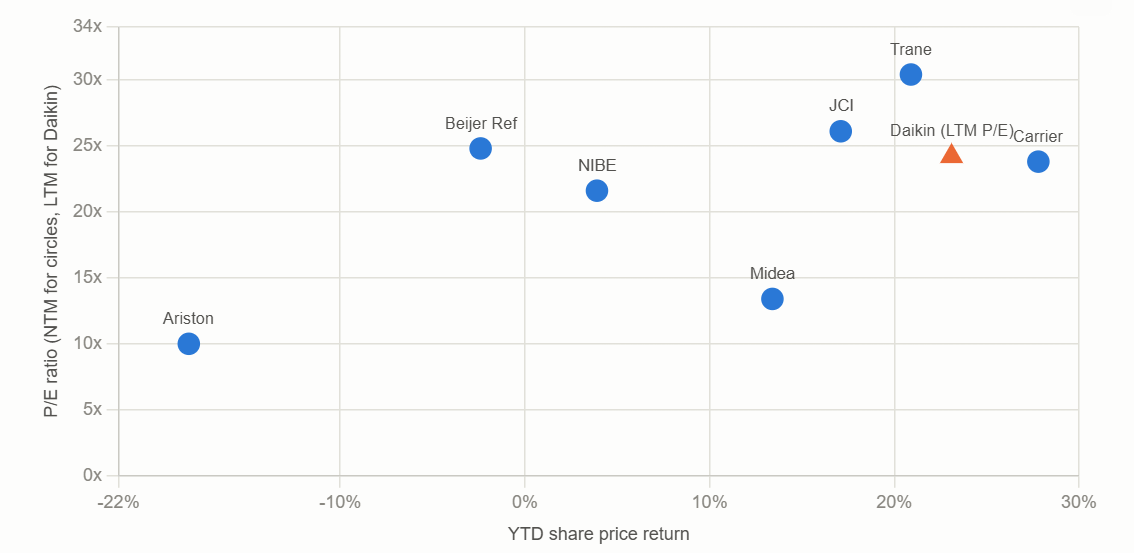
Daikin Industries is the actual global #1 in AC by revenue (~90% of sales from air conditioning), with Europe as one of four core markets. Elliott Management also took a ~3% stake in April pushing for margin and capital-return reform, which might act as another tailwind for stock price returns in the medium term.
“Investors are consciously thinking about [climate change]. Extreme heat events are accelerating what was already a structural replacement cycle — ageing equipment that was ‘good enough’ in a milder climate suddenly becomes inadequate when temperatures consistently exceed design thresholds” - Mizuho industry analyst
Many of these names also serve the data centre market which as we all know has been a huge driver for anyone that serves that market. Aditionally, EU's revised F-gas Regulation (2024) which is phasing out HFC refrigerant quotas on a fixed legal timetable (48% cut by 2025–26), forces a replacement cycle regardless of weather and is a tailwind that is rarely mentioned for the industry.
One to watch out for.
4. Venture is not venture anymore
Q2 2026 Pitchbook NVCA Venture Monitor
Q2 saw the second highest deal value (after Q1) in a decade in VC. Everyone, however seems to be playing the same game. 86% of all deal dollars went into AI, with more than 87% of all deal value being mega-deals.
Median deal values continue to skyrocket in AI (which means entry prices in these deals have sky high growth expectations). For instance, median valuation for series D+ companies is 7x higher for an AI company as compared to a non-AI one.
There is extreme concentration at every level - deals, exits and even fundraising.
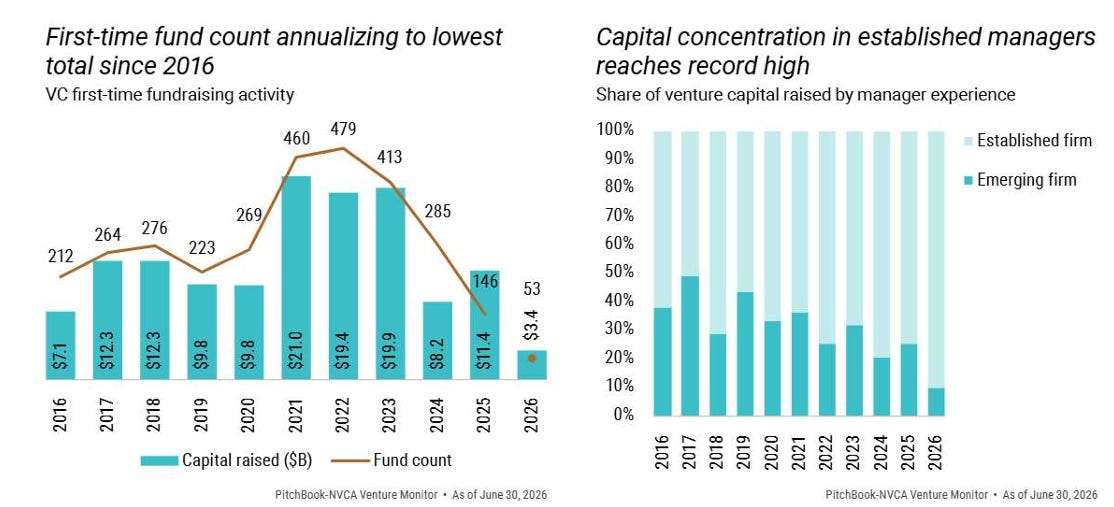
Experienced firms took in 89% of the capital, the highest in a decade. The mega fund phenomenon continues to roll on where large platforms eat up the entire market, and divert that capital into the same sectors and startups.
For skilled emerging managers who have more flexible capital and are playing a different game, this creates an attractive playing ground to find quality where others are not looking. The outlier bets that OG venture capital was all about.
5. The other side of venture’s concentration problem
Sarah Guo - Profile by Colossus
If experienced firms are hoovering up capital at the fund level, the same thing is happening at the company level, just with fewer names. In Q1 this year, the biggest quarter for venture in history, 65 cents of every dollar went to four companies that already exist: Anthropic, OpenAI, xAI, and Waymo. Not young companies or the unproven ones. The four most obvious names in the industry, already worth hundreds of billions each.
Sarah Guo’s Conviction is exactly the kind of outlier bet that gets squeezed out when everyone chases the same few names. Her three funds add up to under a billion dollars combined, less than a single round into any of those four labs. But she’s not even trying to compete there. She’s betting the labs can’t own the whole AI stack, and that real value still sits in what gets built on top of and around them. Companies with actual customer trust and infrastructure needs the labs would rather not serve.
There hasn´t been any IPO or large exits out of her portfolio so far. But as they say in venture, these are what the outlier bets look like. When they pay off, they return your fund, and then some.
Until next time,
The Atomic Investor
🤗 so much effort behind all