

“Here’s how to properly hate him.” That was The Globe and Mail’s response to Friday’s SpaceX IPO. Not a profile of a historic event. Not even a critical assessment. Just a user manual for contempt.
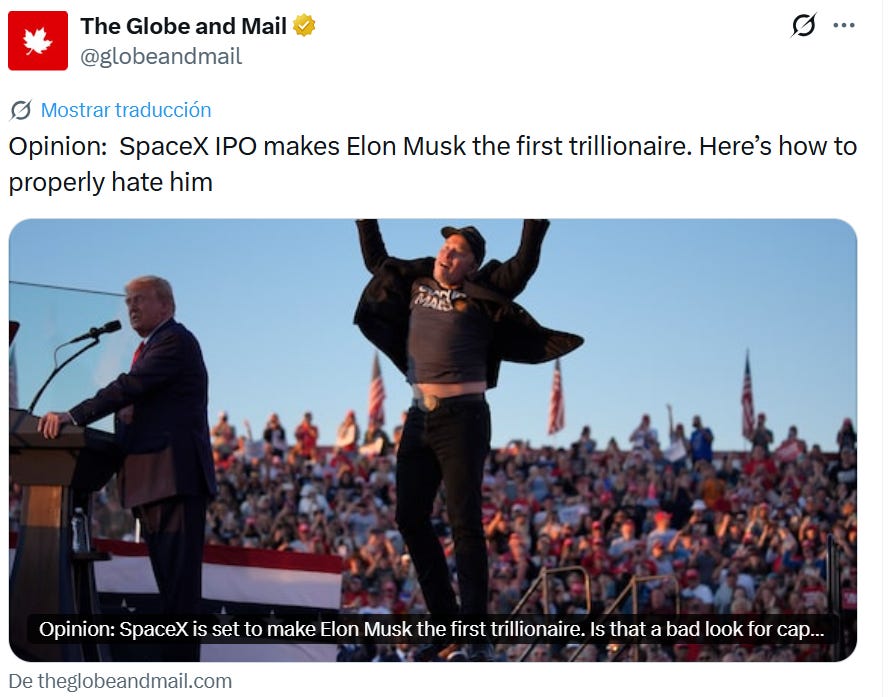
The IPO itself was the largest in history. SpaceX raised $75 billion and listed at a $2 trillion valuation, the sixth most valuable public company in the United States. The man who built it now holds a paper net worth of over a trillion dollars, the first time any human being has crossed that line.
I want to be honest about a few things here. I am a fan. I think what Elon Musk has built across SpaceX, Tesla, and his other ventures is one of the most impressive industrial feats of the past half century. So maybe take everything that follows with that bias accounted for.
What was agonising to see was the framing the media and political class chose, almost in unison, was that the IPO was a wound inflicted on everyone else. Politicians came out with the worst takes ever using the moment for their own political gains.


But wealth is not zero-sum, and Friday’s IPO is the cleanest proof of that we have had in a long time.
Money is not wealth
Paul Graham’s old essay How to Make Wealth still says this best.
Money is a medium we use to move things around. Wealth is the actual stock of useful stuff that exists in the world: cars that run, houses that stand, software that works, rockets that fly. Money at any given moment is finite. Wealth is not. Take a beat-up car and spend a summer restoring it, and the world has one more pristine car than it had before. You are richer. No one else is poorer.
That is the test. Almost nothing about how the political class talks about billionaires passes it.
What Musk has built across SpaceX, Tesla, and Starlink et all does pass it. He has expanded the stock of useful things in the world. By a lot.
What was actually built
Musk is not a sympathetic public figure to a lot of people. The X feed, the politics, the personal conduct, the way he uses his platform. I get it. I disagree with him on plenty too. You are allowed to dislike the man without ignoring all the good he has done and he is doing.
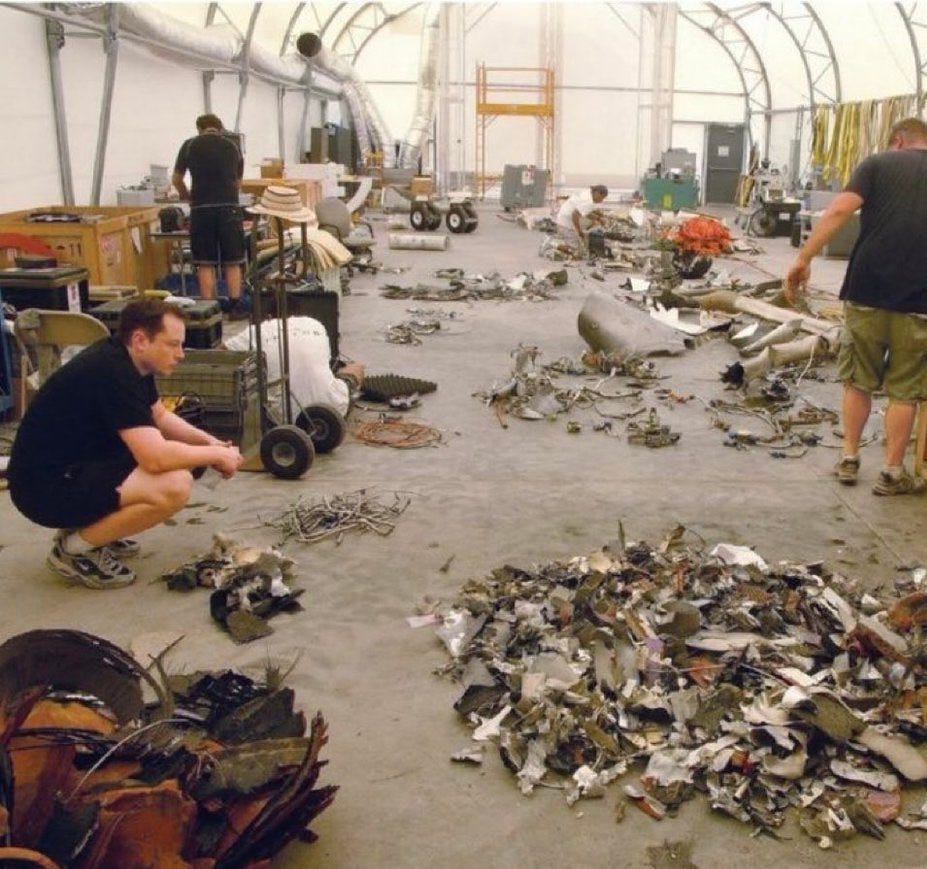
SpaceX was never supposed to exist. Three failed launches in 2006, 2007, and 2008. The company went nearly bankrupt. Then orbit on the fourth attempt. Then NASA contracts. Then the first commercial cargo to the ISS. Then vertical booster landings. Then drone ship landings. Then the first reuse of a booster. Then the same booster flown 10 times, then 20, then more. Then catching a Super Heavy booster out of the air with the launch tower itself, an idea most of the industry openly said was insane until it worked.
SpaceX today launches the majority of the mass that reaches orbit globally each year. The legacy primes have spent two decades trying to copy what one private company did, and most of them are still behind.
Starlink is the same story at consumer scale. Affordable, fast satellite internet was widely considered a graveyard product, with Iridium and Globalstar as the cautionary tales. Today Starlink operates the largest satellite constellation ever launched, serves rural customers who had no broadband at all, and has been adopted by airlines worldwide, and more as the standard for inflight WiFi. Airplane WiFi has stopped being a luxury, and that is a direct gift from one private company that almost everyone, ten years ago, would have bet against. Yes now you lot can also scroll your feeds on your flights.
Tesla is a third example. Before Tesla, the EV was a curiosity. After Tesla, every major automaker has had to retool around it. BYD, VW, Hyundai, Ford, GM. The pricing curve, the charging network, the manufacturing methods, the software stack. They all have a Tesla shape now. You can argue Tesla itself may be overvalued (I do, often) and still concede that the company changed the trajectory of an industry on which a meaningful share of global emissions depends.
This is what wealth creation actually looks like at the upper bound. Things that did not exist now exist, work, and are getting cheaper.
Schumpeter’s gale and the price of progress
There is a deeper anxiety in the reaction that is worth naming. New wealth, by being created, devalues old wealth. Schumpeter called this creative destruction, and he called it the “perennial gale” of capitalism. SpaceX’s existence has made ULA, Arianespace, and Roscosmos less valuable. Here is what Ariane’s CEO had said about SpaceX back in the day.


Starlink has made other satellite networks close to obsolete. Tesla’s existence has cost the legacy automakers billions in stranded investments and slow pivots.
That is not a flaw in the system. It is the system doing exactly what it is supposed to do. Every old factory, every legacy product, every incumbent moat eventually faces a challenger that does the same thing better or cheaper, and the wealth migrates to the challenger. The discomfort of the political class is that the people who built the new thing get rich in the process. The price of progress is that the old loses value, and a taxing that progress and the process behind it framing freezes that in place.
Schumpeter’s gale does not care for static companies, ideas and wealth. They get eroded the natural way. By the next SpaceX. By the next Tesla. By the next thing no one has built yet. The right question is not how to clip Musk today. The right question is what conditions make the next builder possible.
No one else was made poorer. Quite the contrary
The political framing and the reaction around it assumes the trillion is sitting somewhere liquid and unproductive. It isn’t. The trillion is the market’s price for owning a share of what Musk and tens of thousands of people built.
Brad Gerstner’s response to Ro Khanna hit the nail where it should be hit. Imagine, he said, a 2002-era policy that had taxed Musk’s PayPal proceeds at 100%. There is no seed money for any of it. Because that is exactly what Musk did with the PayPal exit. eBay bought PayPal for $1.5 billion in 2002, and Musk walked away with $180 million. He put $100 million into SpaceX, $70 million into Tesla, $10 million into SolarCity. He borrowed money for personal expenses for years afterwards.
The trillion is what those three decisions compounded into and the society itself is much richer because of that.
Also, SpaceX’s IPO has minted roughly 4,400 employee millionaires, with around 400 of them holding stakes worth $100 million or more, per a New York Times analysis of Hill.com data. The most-told story is Juan Hernandez’s, who joined SpaceX as a welder in 2015 earning $28 an hour, took $10,000 of stock he didn’t think much about at the time, and is now sitting on roughly $1 million in SPCX shares. Friday’s IPO is on track to be one of the largest single employee wealth-creation events in market history.
Letting Musk keep that $180 million produces SpaceX, Tesla, Starlink, the reusable rocket, the largest satellite constellation ever built, the modern EV industry, hundreds of thousands of jobs, and 4,400 newly minted millionaires inside one company alone. No one was made poorer for Juan Hernandez becoming a millionaire. And Hernandez is one of thousands.
The trillion at the top exists precisely because the company also created hundreds of $100M outcomes and thousands of $1M outcomes below it.
We are looking at the wrong thing
I find the reaction to Friday’s IPO frustrating not because I think Musk is owed celebration, but because the framing is so badly off. The dominant story is “trillionaire bad.” A truer story would be “$180 million in PayPal proceeds, applied with extreme conviction over two decades, built two industries from scratch, created thousands of millionaires inside its own walls, and made products that the rest of the world now uses every day.”
We are paying less attention than we should to the kind of wealth creation that actually moves civilisation forward, and far too much attention to the size of the resulting bank balance. The two are not the same thing, and conflating them makes for cheap political copy and worse public reasoning.
If we want more of SpaceX, more Teslas, more Starlinks, and more entrepreneurs working on hard problems then we should be very careful about the story we tell ourselves on days like Friday. Because the story we tell determines who tries the next absurdly hard thing and gives making the world wealthier a better shot.
Until next time,
The Atomic Investor.
amazing @atomic investor💯💢